Energy, data, environment
1487 stories
·
2 followers

World's first undersea data center powered by offshore wind is online

1 Share

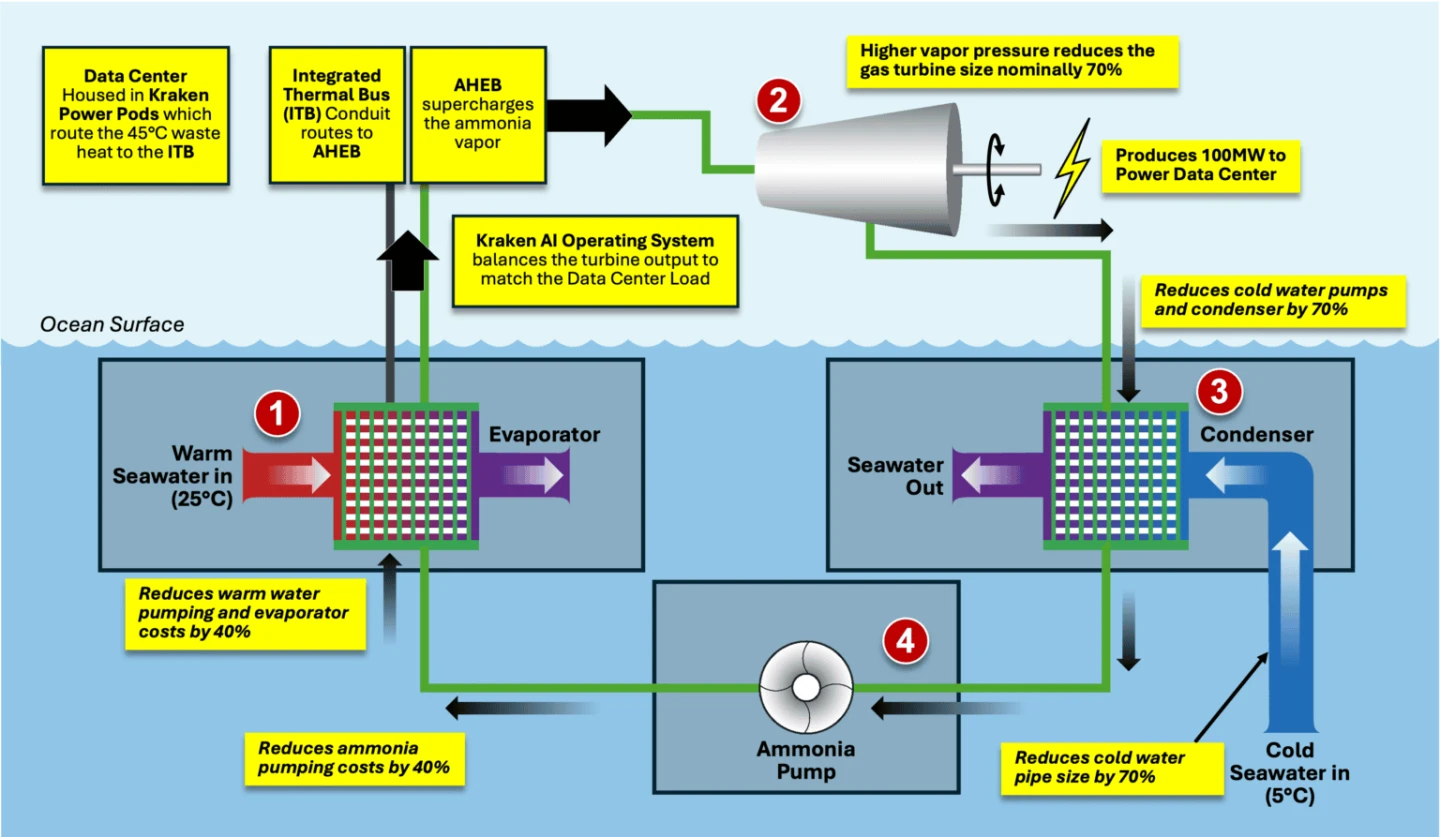
Just over seven months from completing phase one of this mega-project, Chinese engineers have finished the build and switched on the world's first underwater data center (UDC) powered by offshore wind turbines. What's more, it doesn't need freshwater and cuts land use by more than 90% compared with above-ground centers.

We reported on the big build in October 2025, when the first stage had been constructed. At the time, there was no projected timeline for it to become operational. The underwater infrastructure, off the coast of Shanghai in the Lin-hang Special Area, was officially switched on in late May, and it's far more impressive than it may sound on paper.

Data centers don’t need freshwater to function – but it remains the simplest cooling option, as it puts fewer demands on surrounding infrastructure, thanks to its lower levels of salts, minerals and biological impurities that can corrode pipes or reduce cooling efficiency over time. Unlike many inland facilities that still rely on freshwater, UDCs instead use the surrounding ocean as a heat sink, transferring this heat through sealed cooling systems.

This center, built by a subsidiary of China Communications Construction, uses a circulating copper-pipe heat exchange system that reportedly reduces electricity consumption by 22.8%. Offshore wind farms are also estimated to generate 95% of the electricity needed to run its 192 server racks across four levels, significantly reducing reliance on existing power infrastructure.

"For an undersea data center of the same scale, the electricity used for cooling would only account for about one-tenth of total power consumption," Tsinghua University Professor Li Zhen told China Daily. "If data centers of the same scale were placed underwater, even allowing extra margins, cooling consumption could fall to around 30-billion kW. That would save about 50 billion kWh of electricity each year."

According to state media, the center is currently operating at 2.3 MW – but has a planned capacity of 24 MW (enough to power 20,000 households). This "room to move" is essentially future-proofing the UDC's usefulness, as companies turn their attention from initial builds to longevity when it comes to hardware upgrades and compute capacity.

Nonetheless, while UDCs may reduce freshwater demands and land use, underwater computing is still a largely unknown at commercial scale. Questions remain around how these facilities will endure – and what the ecological effects of continuously releasing heat into local marine environments might be.

But considering tech companies are racing to put data centers in space to meet rising demand, real-world projects like China's UDC could serve as valuable test cases in the AI age, revealing whether moving computing infrastructure into new environments can offset existing land-based issues – or reveal entirely new ones.

Source: China Daily

Read the whole story
strugk
23 hours ago
reply
Cambridge, London, Warsaw, Gdynia
Share this story
Delete

A Fundamental Principle of Aeronautical Engineering Has Been Overturned

1 Share

Aerodynamic drag is a major “barrier” in high-speed airplanes, automobiles, and bullet trains. This is because a design with less aerodynamic drag allows the aircraft to move at higher speeds with less energy.

When an aircraft or car body moves at high speed, a thin layer of air called the boundary layer is formed on its surface. This boundary layer has two states: laminar flow, in which air flows in an orderly fashion, and turbulent flow, which is chaotic.

WIRED's Guide to How the Universe Works

Your weekly roundup of the best stories on health care, the climate crisis, new scientific discoveries, and more.

The longer the air stays in the laminar-flow state with low friction, the smaller the air resistance becomes, but as the air speed increases, it transitions to turbulent flow. The key to reducing aerodynamic drag is delaying this transition to turbulence.

For more than 80 years, a basic principle of aeronautical engineering has been that the surface of an object must be smooth in order to reduce aerodynamic drag. This premise was based on the results of a 1940 study by Ichiro Tani, a Japanese scientist who demonstrated the relationship between surface roughness (an indicator of the state of the machined surface) and turbulent transition, arguing that surface roughness, which was unavoidable with the manufacturing technology of the time, prevented laminar flow from being realized.

However, in 1989 Tani reinterpreted the experimental data on rough-surfaced pipes obtained by fluid engineer Johann Nikulase in the 1930s, suggesting that “roughness may not necessarily only promote turbulent transition and increase fluid resistance.” (In physics, air is considered a fluid.) Inheriting this idea, a research group led by Yasuaki Kohama of Tohoku University demonstrated in the 1990s that fibrous rough surfaces, which have fine fibrous irregularities on their surface, have the effect of delaying transition under certain conditions.

The same Tohoku University research team recently announced a discovery that significantly advances this idea. Aiko Yakino, associate professor at Tohoku University's Institute of Fluid Science, and her research group were the first in the world to demonstrate that aerodynamic drag can be reduced by up to 43.6 percent simply by applying distributed micro-roughness (DMR), a surface roughness so fine and irregular that it cannot be distinguished by the naked eye.

This technology is fundamentally different from the rivulet (“shark skin”) process, which is a known air-drag-reduction technology. The rivulet process mimics the fine longitudinal grooves in shark skin, and by carving grooves approximately 0.1 millimeter wide along the direction of airflow, it aligns the vortices that occur near the wall surface of turbulent airflow areas. DMR, on the other hand, delays the switch from laminar to turbulent flow by means of random and minute irregularities. The flow zones it affects and the mechanisms it employs are based on completely different concepts.

Precise Measurement in a Wind Tunnel Without Support Bars

A key factor in this achievement was the use of a new wind tunnel method. Conventional wind tunnel experiments had structural limitations: The support rods and wires essential for supporting the model disrupted the airflow, negating the minute changes in air resistance caused by micro-scale roughness.

The world's largest 1-meter magnetic support balance system (1m-MSBS), owned by the Institute of Fluid Science, Tohoku University, has fundamentally solved this problem. This device can levitate a streamlined model approximately 1.07 meter in length inside a wind tunnel without contact using electromagnetic force. Because it does not use any support rods or other means, it completely eliminates interference with the airflow around the model.

Yakino and her team precisely measured the total drag coefficient on smooth and DMR-coated surfaces over a wide range of Reynolds numbers, from 0.35 x 10⁶ to 3.6 x 10⁶. (A Reynolds numbers is the ratio of inertial to viscous forces within a fluid; it’s a key predictor of whether fluid flow will be laminar or turbulent.

Read the whole story
strugk
1 day ago
reply
Cambridge, London, Warsaw, Gdynia
Share this story
Delete

Energy storage breakthrough traps sunlight in a molecule

1 Share

Beyond the rather low efficiency of today’s solar panels in converting the power of the sun into electricity, the transformational potential of solar energy is presently held back by battery storage technology.

A new, molecular-scale breakthrough could unlock a new path to long-term solar energy storage for heating homes and providing hot water – without a conventional battery in the equation.

How in the world would that work? To answer that, we need to take a quick dive into the world of electrochemistry. So grab your coffee and settle in.

Batteries store power as chemical potential energy. The energy stored in a chemical battery exists as a sort of tension and imbalance in how atoms and electrons are arranged between two materials. When a battery charges, external energy forces electrons and ions into higher-energy configurations where they wouldn't naturally want to stay, creating potential energy. It's the chemical equivalent of lifting a weight onto a high shelf or compressing a spring.

That potential energy remains stored as tension until the circuit closes, and the electrons can flow through that circuit from the anode back to the cathode toward a lower-energy state. In energetic terms, they’re simply moving downhill, releasing that stored potential energy, which we harness as electrical current flowing through the circuit.

It’s a system that works remarkably well, which is why batteries have become the backbone of modern electronics. But, like everything else in life, they also have limits. Over time, batteries begin to degrade and release a chalky white residue, or else begin to swell up and release heat – familiar warnings of failure. They also rely on complex materials, and aren’t always ideal for storing energy over long periods.

For solar power in particular, batteries introduce extra steps. First, sunlight must be converted through photovoltaic panels into electricity, which is then stored in a battery. When that energy is needed, it has to be pulled back out, routed through a circuit, and converted again into something usable, whether that’s light, heat, or motion.

Harnessing the power of the sun in molecules could allow a complementary energy storage method for heating

Harnessing the power of the sun in molecules could allow a complementary energy storage method for heating

But researchers at UC Santa Barbara say they've managed to vastly simplify the overall system. In a groundbreaking study recently published in Science, the team claims to have developed an organic molecule capable of absorbing sunlight and storing it directly within its own chemical bonds. And this molecule beats the energy density by weight of all but the most experimental (and dangerous) lithium batteries.

The molecule, called Pyrimidone, is derived from structures related to the building blocks of DNA. Here, the team has modified it into a compact system designed specifically to capture solar energy. Scientists refer to technologies like this as Molecular Solar Thermal Storage, or MOST.

“In MOST systems, energy is stored in chemical bonds rather than as heat or electrical charge,” said Han Nguyen in an email to New Altas. “Chemical bonds are generally stable, which allows energy to be stored for long periods without significant loss. In our pyrimidone-based system, the energy is stored in a strained form called the Dewar isomer. Once the molecule is in this form, it remains there until we deliberately trigger its release of energy.”

What she’s describing happens within a single molecule. Instead of moving electrons between materials, this system works internally. When sunlight hits the structure, it shifts into a strained configuration that locks potential energy into its chemical bonds.

In some ways, the molecule behaves like a tiny molecular mousetrap. Sunlight sets the trap, pushing the structure into a tense, high-energy position. Chemists refer to this kind of structural switch as photoisomerization, a process in which light changes a molecule’s geometry without breaking it apart.

In this system, that reversible shape change acts as the storage cycle itself. To release the energy, an acid catalyst is applied. What makes it especially interesting to the modern energy storage mix is that the energy is released as heat, not electricity – "enough heat to boil water," according to the study.

Most renewable energy systems today are designed to store electricity, when in fact what you often want to come out the other end is actually heat. Hot water, many industrial processes, and building heating all rely on thermal energy, so energy stored in traditional batteries needs to go through another conversion step. The MOST system is designed to cut out the middle man and meet that need directly.

“We see it as a complementary technology, not a replacement for what already exists,” said Han Nguyen. “The energy landscape increasingly relies on photovoltaic panels paired with lithium-ion batteries, and those systems are excellent for electricity. But roughly half of global energy demand is for heat — warming homes, cooking, providing hot water — and for that application, a system that stores and delivers heat directly is a more natural fit.”

In terms of efficiency, this is a genuinely remarkable energy storage solution. It holds 1.6 megajoules of energy per kilogram of material. That equates to around 444 Wh/kg – nearly twice what you'd typically see in the lithium-ion packs running today's EVs, and not far off what CATL has achieved with its frankly scary 500 Wh/kg "condensed battery."

But the technology is still in its early stages, and researchers are currently working to improve efficiency, durability, and scalability before the system can move beyond the lab.

“The most immediate challenge is improving how efficiently the molecules charge under sunlight,” said Nguyen. “At present, our pyrimidone absorbs primarily in the ultraviolet range, which represents only a small fraction of the solar spectrum. We need to shift absorption toward visible wavelengths to make better use of the energy available outdoors.”

Researchers are also exploring structural tweaks to the molecule that could expand its absorption range into the visible light spectrum while maintaining its energy density and stability.

Beyond improving how the molecules absorb sunlight, the team is also focused on making the system practical to use.

“On the device side, we are working to replace the homogeneous acid catalyst used in our proof-of-concept experiments with heterogeneous catalysts, i.e., solid catalysts that can be embedded in a flow channel and reused indefinitely,” said Nguyen.

That means swapping out a one-time-use liquid component for a solid material that can be built into a reusable system. It’s a shift that would allow the technology to cycle repeatedly, capturing and releasing heat without needing to be reset each time.

With those pieces beginning to fall into place, even at this early stage, the team’s work is already reshaping how we think about energy storage. For more than a century, storing energy has largely meant relying on batteries. Here, that shift takes a different form, with sunlight captured and held not in metals and moving electrons, but in the shape of molecules themselves.

This study was published in the journal Science.

Read the whole story
strugk
53 days ago
reply
Cambridge, London, Warsaw, Gdynia
Share this story
Delete

Why Insect Farming Startups Are Going Bankrupt

1 Share

The proclamation came from, of all people, an insect researcher: “We have to get used to the idea of eating insects.”

Dutch entomologist Marcel Dicke pitched eating bugs in his 2010 TED talk as critical to sustainably feeding a growing human population, because insects have a much smaller carbon footprint than beef, pork, and chicken.

To make his point, he even featured photographs of what might be a common meal in this bold new future: A stir fry with mealworm larvae, mushrooms, and snap peas, finished with a chocolate dessert topped with a large fried cricket.


This story was originally published by Vox and is reproduced here as part of the Climate Desk collaboration.


Three years later, the United Nations published a comprehensive report that echoed many of Dicke’s ideas and argued that insects could be a more eco-friendly food source not just for humans, but also for livestock. The report received widespread media coverage and helped to trigger a wave of investment from venture capital firms and governments alike into insect farming startups across Europe, the U.S., Canada, and beyond, totaling some $2 billion.

There’s a ring of truth, it turns out, to the conspiracy theory that the globalist elites want us to eat bugs.

This money was pouring into insect agriculture at a time when investors and policymakers were hungry for new models to fix the conventional meat industry’s massive carbon footprint. And what’s more disruptive and novel than farming and eating bugs?

You personally might recoil at the thought of eating fried crickets or roasted mealworms, but many cultures around the world consume insects, either caught from the wild or farmed on a small scale. And while grubs don’t feature prominently in current paleo cookbooks, our paleolithic ancestors most certainly ate plenty of bugs.

But the past decade has shown that even if you build an insect farm, the global market may not come. Of the 20 or so largest insect farming startups, almost a quarter have gone belly up in recent years, including the very largest, Ÿnsect, which ceased operations in December.

All told, shuttered insect farming startups account for almost half of all investment into the industry.

“Things have gone from bad to worse for the big insect factory business model,” one insect farming CEO said late last year in a YouTube video.

And Vox can exclusively report that plans to build a large insect farm in Nebraska — a joint project between Tyson Foods, America’s largest meat company, and Protix, now the world’s second largest insect farming company — are indefinitely on hold.

“The human food market, basically, has not materialized.”

Beyond the financial woes of the insect farming industry, some philosophers worry about the ethical implications of potentially farming tens of trillions of bugs for food, as emerging research suggests insects may well have some form of consciousness and hold the capacity to feel pain and suffer.

“Evidence is building that there’s a form of sentience there in insects,” Jonathan Birch, a philosopher at the London School of Economics who leads the Foundations of Animal Sentience project at the university, told Vox last year.

But it looks like they may not have too much to worry about. In spite of the initial hype surrounding the bug farming boom, the insect agriculture industry has learned just how difficult it is to compete with the incumbent, larger animal-based meat industry — and that, perhaps, it never really made sense to try doing so with bugs.


Insect farming is similar to other types of animal farming. The insects reproduce, and the offspring are raised in large numbers in factory-style buildings. Many of the same welfare concerns for farmed chickens and pigs are present on insect farms, like disease, cannibalism, and painful slaughter. In the case of insects, the creatures are killed by a variety of means. They might be frozen, baked, roasted, shredded, grinded, microwaved, boiled, or suffocated.

In 2020, insect companies farmed an estimated one trillion bugs, and the most commonly farmed species today are black soldier fly larvae, mealworms, and crickets.

While some people might tell researchers they’re open to adding bugs to their diet, these smallest of animals remain a novelty food in the U.S. and Europe, as opposed to a commodity capable of displacing wings or burgers.

“The human food market, basically, has not materialized,” Dustin Crummett, a philosopher and executive director of The Insect Institute — a nonprofit that researches the environmental and animal welfare implications of large-scale insect agriculture — said in an interview. “Only a tiny fraction of farmed insects are used for human food.”

Some philosophers worry about the ethical implications of potentially farming tens of trillions of bugs for food, as emerging research suggests insects may well have some form of consciousness.

But insect farming startups haven’t only sought to put insects on our plates or grind them into protein bars; many want to sell insect meal (ground up insects) as feed for other farmed animals. It’s a sustainable alternative, they argue, to the soy fed to factory-farmed chickens and cattle, much of which is grown on deforested land. Insect meal could also replace fishmeal (largely composed of small, wild-caught species, like anchovies and sardines), which is fed to farmed fish and heavily contributes to overfishing.

This approach of farming insects for livestock feed, however, isn’t materializing either, and much of it comes down to cost.

According to a 2024 analysis published in the journal “Food and Humanity” and co-authored by Crummett, one ton of insect meal costs about 10 times that of soybean meal and 3.5 times that of fishmeal, a major cost gap that is unlikely to narrow anytime soon.

Insect meal is so expensive, in part, because feeding insects is expensive.

Get Our Newsletter

Sent Weekly

Farmed insects are typically fed agricultural “co-products” — like wheat bran and corn gluten — most of which is already fed to livestock, and so insect farmers have wound up in competition with big meat companies to buy up these ingredients. This simple fact weakens the narrative often driven by insect farming startups that they are putting food scraps that otherwise would’ve been thrown away to good use.

“Organic waste from the industry becomes feed for insects,” Protix’s website reads. “This circular food production mirrors nature’s circle of life.” But this is misleading; Protix feeds its insects ingredients like oat husk and starch, which are typically used in traditional livestock feed anyway.

“It doesn’t really make sense to buy chicken feed to feed insects to feed to chicken,” as one insect farming startup founder told AgriTech Insights a couple of years ago.

And it’s not guaranteed that insect meal will be more sustainable than soy or fishmeal. According to a UK government report, the environmental impact of insect farming depends on a number of factors, including what insects are fed and whether startups power their farms with fossil fuels or renewable energy.

“It doesn’t really make sense to buy chicken feed to feed insects to feed to chicken.”

Energy usage explains a lot of the industry’s cost challenge. Farmed insects require warm temperatures, and in Europe, where so many of the startups are based, energy prices have sharply risen in recent years.

To lower costs and develop new revenue streams, some insect farming startups have pivoted to become “waste management” companies, too. Rotting food waste in landfills is a huge source of global greenhouse gas emissions, and insect farming companies can earn money by taking it off other companies’ hands and letting bugs eat it.

But here, too, the industry has run into obstacles, including strict EU regulations around what can be fed to insects and an inconsistent product. When insects are fed food waste, their final nutritional profile can vary widely depending on what they’re fed, but livestock feed companies need nutritional consistency.

And it turns out that even the largest and most powerful companies in the space can run into hard, economic realities when trying to rear bugs on waste en masse.


In late 2023, America’s biggest meat company, Tyson Foods, announced it had invested an undisclosed sum of money in Protix, a large Dutch insect farming startup. That Tyson was putting its weight behind it seemed like much-needed proof that insects could be the future of food, as so many startups, investors, and researchers had claimed.

The two companies planned to build a massive insect farm together near Tyson’s cattle slaughterhouse in Dakota City, Nebraska. At the insect farm, Protix would raise and kill around 70,000 tons of larvae annually — approximately 300 billion individual insects. The bugs would feed on cattle paunch, partially digested plant matter removed from the stomachs of cattle slaughtered at Tyson’s plant. After a few weeks of feeding on the animal waste, the larvae would be slaughtered and ground up into insect meal, destined to become food for pets and livestock.

It was a way for Tyson to “derive value” from its waste, as it told CNN.

Even the largest and most powerful companies in the space can run into hard, economic realities when trying to rear bugs on waste en masse.

Now, Vox can exclusively report that Tyson Foods has withdrawn its air permit application to build the plant, and the plant itself is “on hold indefinitely.” That’s according to email exchanges last December between Tyson Foods and the Nebraska Department of Water, Energy, and Environment, which were obtained through public records requests by the nonprofit Society for the Protection of Insects.

Tyson and Protix did not respond to questions for this story.

The companies’ stalled plans aren’t unique in the insect farming space.

In early 2024, Innovafeed — currently the largest insect farming startup — opened a pilot plant in Decatur, Illinois, in partnership with ADM, the massive food and livestock feed manufacturing company. The U.S. Department of Agriculture awarded Innovafeed a $11.7 million grant to turn insect waste into fertilizer at the plant, but a year and a half after it opened, it suspended operations, citing funding challenges.

Through a public records request, Society for the Protection of Insects obtained over 600 pages of documents pertaining to the grant, though about half of it is redacted, including much of the environmental review and Innovafeed’s commercial records. Earlier this month, the organization sued the USDA over the heavy redactions, arguing it’s in the public’s interest to fully disclose the details of the deal.

The USDA declined to comment on pending litigation, and Innovafeed did not respond to questions for this story.

The biggest blow to the industry yet came late last year when the largest startup of them all — France-based Ÿnsect, which had raised over $600 million, representing nearly a full third of the sector’s funding — ran out of money. And a quarter of that backing had come from the French government. A recent whistleblower investigation alleged severe mismanagement at Ÿnsect’s production facility that led to filthy conditions and health problems for workers. The company didn’t respond to a request for comment.


As insect farming startups struggle to stay afloat, their main trade group — the International Platform of Insects for Food and Feed, or IPIFF — is going so far as to call on the European Union to mandate publicly funded food services, like school cafeterias, to buy insect meat and publicly owned farms to buy insect meal to feed to their animals. IPIFF didn’t respond to an interview request for this story, nor did the North American Coalition for Insect Agriculture.

As for the outlook of the insect farming sector, more startups will probably go under in the years ahead, and for the survivors to continue on, they may need to leave Europe and North America for warmer climates and lower operating costs.

“It is not at all unusual that some new thing gets hyped as the silver bullet that’s going to solve such and such environmental problem.”

But the rise, fall, and resettling of the industry isn’t uncommon in the agricultural technology field, Crummett says. Vertical farming, for example, seemed like a great idea on paper, but it’s been an economic failure.

“It is not at all unusual that some new thing gets hyped as the silver bullet that’s going to solve such and such environmental problem,” Crummett said, especially when it’s a striking idea — eating insects — and is backed by influential institutional actors, like the United Nations and university researchers.

But it’s undeniable that the insect agriculture sector’s ambitions have fallen far from disrupting the meat and livestock feed supply to a future in smaller niche markets, like pet foodnovelty human foods, waste management, and livestock feed additives.


Newsletter Journeys

SIGN UP FOR NEWSLETTER JOURNEYS:  Dive deeper into pressing issues with Undark’s limited run newsletters. Each week for four weeks, you’ll receive a hand-picked excerpt from our archive related to your subject area of interest. Pick your journeys here.


It all amounts to a massive retrenchment from its ambitious goals of revolutionizing the food system to now merely tinkering at its edges.

But in another way, it was never truly ambitious enough. Decades of environmental and food systems research has concluded that what we ultimately need is fewer animals — be them chickens; pigs; birds; fishes; or, yes, bugs — in farms and on our plates.


Kenny Torrella is a senior reporter for Vox’s Future Perfect section, with a focus on animal welfare and the future of meat.

Read the whole story
strugk
55 days ago
reply
Cambridge, London, Warsaw, Gdynia
Share this story
Delete

Why the Iran War Could Last Far Longer Than Either Side Wants to Admit

1 Share

And support our mission to provide fearless stories about and outside the media system

Oil prices have been spiking since the closure of the Strait of Hormuz, leading reporters and analysts to ask when the war will end. They generally ask President Trump, whose answer varies from “very soon” to “four to five weeks”. Defence Secretary Pete Hegseth says it is anywhere between three to eight weeks. But whatever the date given, the assumption is that the war ends when the United States says it is over.

However, this assumption ignores the reality of warfare, where “the enemy also gets a vote”. Both the US and Iran have their own theories of victory and their own “termination conditions” for the war – and those conditions are mutually exclusive. If the United States declares victory but Iran keeps the Strait of Hormuz closed with mines and Uncrewed Surface Vessels (USVs), the war is not over. Both sides appear to fundamentally misunderstand the situation, and this analysis concludes that the conflict will likely go on for far longer than either side wants.


Theories of Victory

A theory of victory is the broad plan for how a country will end a conflict and get its adversary to agree to favourable terms. A 2024 study by the RAND Corporation – a US defence think tank – defines it as “a causal story about how to defeat an adversary” that identifies the conditions under which the enemy will admit defeat and outlines how to create those conditions.

The authors highlighted five general types of victory: dominance, denial, devaluing, brinksmanship and cost imposition.

Dominance (such as unconditional surrender) means comprehensively defeating the enemy, leaving it physically unable to defend against further attacks or mount counterattacks.

Denial means convincing the enemy that it cannot win, even if it cannot be decisively defeated.

Devaluing means convincing the enemy that any victory will be Pyrrhic – not worth the cost.

Brinksmanship convinces the enemy that the risks of vertical escalation – responding to an attack with an even greater counterattack – are too great.

Finally, cost imposition convinces the enemy that continuing the war will cost too much to justify.

Each adversary creates a theory of victory from one or more of these, to convince the other side to sue for peace on favourable terms. It is cost imposition that both the US and Iran are pursuing, in different ways.

A nation’s goals and objectives for a war are about what it wants to achieve; its theory of victory is about how it plans to achieve them. Therein lies the problem for the United States.


The United States’ Theory of Victory

The Trump administration’s stated goals have been constantly shifting, but appear to have settled on destroying Iran’s navy, eliminating its ability to launch and produce missiles, preventing Iran from supporting proxies and ensuring Iran can never produce a nuclear weapon. These are goals, however, rather than a plan for how they will be achieved.

President Trump has called for Iran’s “unconditional surrender”. The last two countries that unconditionally surrendered to the United States were Germany after Berlin fell and Japan after Hiroshima and Nagasaki.

Inducing unconditional surrender with only a conventional air campaign seems highly unlikely without extreme vertical escalation – use of a nuclear weapon, destruction of Iranian freshwater infrastructure, or a massive land invasion – none of which the United States has shown any inclination for.

Instead, the US appears to be following a cost imposition strategy. It has targeted much of Iran’s military capabilities and leadership, but has not yet broadly attacked oil production, electricity or water resources.

It is unclear how much destruction Iran is willing to endure, but the threshold is likely very high: the leaders making decisions are not beholden to the people, nor greatly affected by the conflict aside from the risk of dying in an air strike. So far, Iranian leadership has made it clear it is uninterested in returning to the negotiating table.


Iran’s Theory of Victory

Iranian demands for a peace agreement were posted on X by Iranian President Masoud Pezeshkian, who wrote that “the only way to end this war – ignited by the Zionist regime & US – is recognising Iran’s legitimate rights, payment of reparations, and firm international guarantees against future aggression”. “Legitimate rights” presumably include Iran’s right to develop nuclear power. Both demands are non-starters for the United States and Israel. Like the US, Iran’s theory of victory is one of cost imposition – but it differs in the details.

Iran has imposed cost in several ways. It has destroyed expensive equipment, such as the AN/FPS-132 ballistic missile radar worth roughly half a billion dollars. It is forcing the US to expend costly Terminal High Altitude Area Defence (THAAD) and Patriot interceptor missiles against targets that cost far less to produce – the US reportedly used around 800 interceptors in the first week alone – and the US has burned through 10% of its total inventory of Tomahawk cruise missiles in the opening days.

Iran has also closed the Strait of Hormuz, attacking at least 16 vessels, while still moving about 1.5 million barrels of its own oil per day, mostly to China. The Wall Street Journal reports that Iran is selling more oil than before the war, reaping the benefits of high prices caused by the conflict. It has also mounted attacks on Gulf states friendly to the United States, costing their neighbours additional revenue.

The strategic logic suggests Iran believes it can drain enough US military assets, and cause enough economic damage, to encourage sufficient external and internal pressure on the United States and Israel to end the war.

Iran appears to assume that the US military will also want the conflict to end, given the rising costs and slow production of the high-end munitions being used. Tehran likely hopes that high fuel prices and a worsening economy will cause the American public to demand an end.

Iranian leadership appears to believe it can sustain this pressure indefinitely using cheap, easily produced munitions – sea mines, Uncrewed Surface Vessel (USV) suicide drones, similar to those Ukraine used to bottle up Russia’s Black Sea Fleet, and Shaheds – as long as the US does not escalate vertically.

Iran also retains the potential for asymmetric attacks that force the United States to stay engaged, and would likely regard assassination of US leadership figures as horizontal escalation following the killing of Ayatollah Khamenei.

ENJOYING THIS ARTICLE? HELP US TO PRODUCE MORE

Receive the monthly Byline Times newspaper and help to support fearless, independent journalism that breaks stories, shapes the agenda and holds power to account.

We’re not funded by a billionaire oligarch or an offshore hedge-fund. We rely on our readers to fund our journalism. If you like what we do, please subscribe.


The Evidence in Real Time

Real-time evidence supports this reading. For the most part, both sides have left each other’s oil infrastructure intact. Iran wants to court its Gulf neighbours into supporting a negotiated end to the war, where a blockade is more forgivable than destruction of oil infrastructure. The US has avoided striking Iranian oil capacity, presumably to prevent further price spikes – or with a plan to seize the revenue as it did with Venezuela. With the 31st Marine Expeditionary Unit inbound, the US may also be planning to seize Kharg Island and wants it intact.

When Israel struck the South Pars gas field on 18 March, Iran quickly retaliated against oil refineries and natural gas facilities in Saudi Arabia and Qatar. The US quickly disavowed foreknowledge of the Israeli strike (which Israel denied, claiming the US was part of the planning process), producing a rare public rebuke of the Netanyahu Government. Israel subsequently promised not to strike further oil production capacity if Iran does the same – underscoring how the US wants to keep oil prices down, while Iran perceives high prices as a source of internal pressure on Washington.

Historically, wars lose public support over time, and this one started with a low level of support. Iran likely believes the Republican Party will suffer in the 2026 elections if the war significantly damages the US economy.

That is a reasonable assumption: the economy has traditionally been one of the biggest determinants of election outcomes in the United States. If the economy suffers, the US public is likely to lose the will to continue before Iran does, unless something in the equation changes dramatically.

Can the Trump administration declare mission accomplished and go home while Iran is still laying mines, hitting tankers with suicide drones and launching sporadic attacks? Not likely. To extricate itself, the US will have to offer Iran some sort of concession.

Iran, for its part, can always accept a deal it has no intention of honouring – dispersing missile production, developing nuclear capabilities covertly as Pakistan did, or continuing to funnel money to proxies. Iran is incentivised to drag the conflict out, maximising economic pain through closure of the strait to secure the most favourable terms possible.

The energy crisis created if the closure drags on for months will inevitably hurt the global economy. Even if the strait were reopened, the US Navy lacks the capacity to escort normal shipping volumes, and de-mining would take considerable time.


Both Sides Are Making Big Assumptions

Countries sometimes make a faulty assumption about their adversary that dooms their campaign from the start. The Japanese believed that if they hit Pearl Harbour hard enough, the United States would quickly sue for peace. Both the US and Iran may be making comparable errors.

The United States assumes that if Iranian leadership is bombed long and hard enough, it will be amenable to terms. The US and Israel have already killed Ayatollah Khamenei, who was replaced by his more hardline son. The Iranian sense of honour, deeply rooted in Shi’ite culture and Persian history, demands retribution after perceived injustice – a cultural imperative frequently amplified by the state, which frames retaliatory actions as a “badge of honour” or a necessary defence of the nation.

Iranian leadership is therefore unlikely to accept a deal it feels does not favour Iran, unless the agreement contains enough loopholes or lacks sufficient enforcement that Tehran believes it can renege almost immediately.

The US theory of victory does not account for this, or for the desire for retribution that Iran’s new leader might reasonably feel towards the country that killed his father. Both factors make it more likely that Iran would continue fighting even when it was not in its best interest – much as Japan was willing to do until Hiroshima and Nagasaki.

Iran, for its part, may be overestimating Washington’s vulnerability to pressure. US foreign policy no longer seems affected by disapproval, even from long-standing allies. Public opinion may prove ineffective if the administration believes it can retain control of Congress regardless – bills such as the SAVE Act, a voter eligibility law that critics say could suppress turnout, may give it the confidence to continue.

If the administration truly no longer cares what the public thinks, a long-term status quo of a closed strait – with the United States bombing Iranian leadership targets of opportunity almost at random for years – is an ugly possibility.

Iran may also be underestimating the probability that the United States will vertically escalate. Defence Secretary Hegseth has signalled his lack of enthusiasm for rules of engagement or mechanisms meant to prevent civilian deaths.

Targets such as electrical, oil and water infrastructure offer a tempting option for an administration desperate to change the calculus – and the destruction of Iranian freshwater production or storage could create a humanitarian catastrophe severe enough to force a collapse.

Iran’s theory of victory is more coherent than that of the United States, and Iran appears to hold greater control over when the conflict ends. Yet both sides are making faulty assumptions about each other and overestimating their ability to force favourable terms.

However, only one of them controls the Strait of Hormuz – and as long as it remains closed, it is Tehran, not Washington, that sets the price of peace.

For all of these reasons, this conflict is likely to extend towards the worst-case estimates offered by the Trump administration, and probably beyond them.

Read the whole story
strugk
74 days ago
reply
Cambridge, London, Warsaw, Gdynia
Share this story
Delete

Choosing to buy organic food depends more on trust than taste – what our new study in the UK and Japan shows

1 Share

Akarawut/Shutterstock

Organic food is often presented as a healthier, greener or more ethical choice. But when people decide whether to pay extra for organic milk, eggs or vegetables, something else is going on.

Organic food belongs to a curious category that economists call “credence goods”. These are the products whose key qualities can’t be verified even after you’ve bought them. There’s no way that you can tell by looking at, tasting or cooking a food item whether it was genuinely produced to organic standards. Instead, you have to take it on trust.

That makes buying organic less about what’s on the plate and more about what’s going on in people’s heads.

When people pay more for organic food, they are effectively buying a promise: that production followed certain rules, that certification means something and that the system policing those rules is credible. Whether people are willing to pay that premium depends not just on how much the food costs or how much money they earn. It also depends on how much trust they place in the certification and regulatory system behind the label, and how comfortable they are paying more for something they cannot personally verify.

As part of our ongoing research into trust, we conducted two large surveys with around 1,300 respondents in Britain and 1,500 in Japan. We asked people whether they would be willing to pay more for organic versions of everyday foods such as dairy products, meat, eggs and vegetables.

We also asked a few simple questions about trust (both trust in government and trust in other people) as well as how willing respondents were, in general, to take risks.

radishes, jute bag of veg, handwritten chalkboard sign says 100% organic

People who trust the government are more willing to pay extra for organic food. New Africa/Shutterstock

We got the same message back from both countries. In both the UK and Japan, people who trusted the government were more willing to pay extra for organic food. This was true regardless of whether the product was milk, eggs or vegetables, and regardless of age, gender, education or political views.

Willingness to take risks mattered too. People who described themselves as more comfortable taking risks were more willing to pay a premium for organic food. Paying more for something you can’t directly verify is, after all, a form of everyday risk taking.

Trust in other people (what social scientists call “generalised trust”) played a slightly different role. It mattered most when organic food was seen as reflecting personal values, such as environmental responsibility or ethical production, rather than having guaranteed quality.

Where Japan and the UK differ

Comparing results from the UK and Japan helps explain why trust plays such a pivotal role in these shopping decisions.

Japan’s organic certification system is centralised and state-led. Organic food is less common, but public trust in the government remains relatively high. In this context, institutional credibility is crucial. If consumers trust the state, they are more likely to trust the organic label it oversees.

In the UK, organic food is more widely available than in Japan, but certification is fragmented across government bodies and private organisations. Here, trust spreads outwards: confidence in other people, social norms and shared values plays a bigger role alongside institutional trust.

In both cases, however, the basic logic is the same. Organic labels work only when the system behind them is trusted. This has important implications at a time when food prices are rising and trust in public institutions is under pressure in many countries.

Promoting organic food is often framed as a matter of better information or clearer labelling. But our findings suggest that even perfect labels won’t persuade consumers if confidence in institutions is weak, or if paying more feels like too much of a gamble.

When trust erodes, ethical consumption becomes harder. This isn’t because people stop caring about sustainability or animal welfare, but because they stop believing the promises attached to higher prices.

Organic food, then, depends on trust. And without that trust, even the most well-intentioned labels will struggle to sell.

Read the whole story
strugk
86 days ago
reply
Cambridge, London, Warsaw, Gdynia
Share this story
Delete
Next Page of Stories